


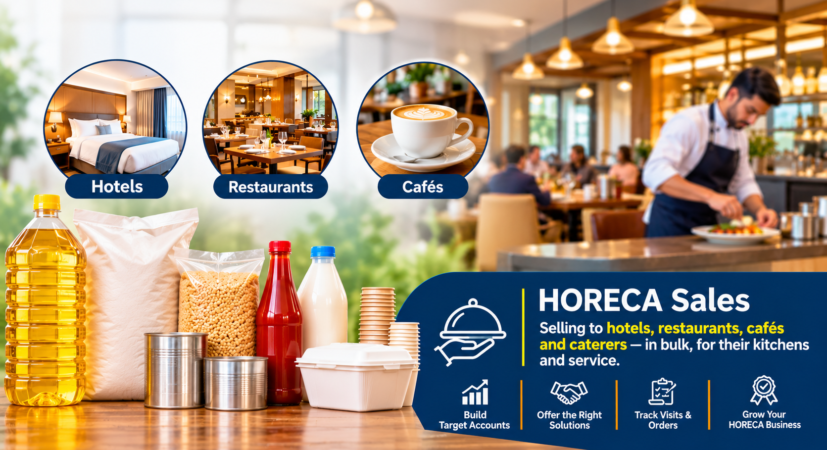
HORECA stands for Hotels, Restaurants and Cafés (some companies read the last part as Catering). In sales, HORECA is the food-service channel: businesses that cook or serve food and drinks for people to consume on the spot, as opposed to shops that sell packs for people to take home.
The word comes from Dutch, where “horeca” is everyday shorthand for the hospitality trade. You will see it written as HORECA, HoReCa or Horeca. All mean the same thing, and most people say it HO-reh-ka.
HORECA full form and meaning
| Letters | Stands for | Typical outlets |
|---|---|---|
| HO | Hotels | Hotels, resorts, guest houses, banquet halls |
| RE | Restaurants | Restaurants, QSR chains, dhabas, cloud kitchens, bars |
| CA | Cafés or Catering | Cafés, bakeries, caterers, office and college canteens |
In FMCG, HORECA sits beside the other main channels:
- General trade (GT): kirana and neighbourhood stores served by distributors and salesmen on fixed beats.
- Modern trade (MT): supermarket and hypermarket chains, bought centrally.
- E-commerce and quick commerce.
- HORECA (also called food service or the out-of-home channel): hotels, restaurants, cafés and caterers.
What does HORECA sales mean?
HORECA sales means selling products to hotels, restaurants, cafés and caterers for use in their kitchens or service, not for resale on a shelf. Typical HORECA products are cooking oil, flour, spices, sauces, dairy, beverages, frozen foods, packaged water, disposables and cleaning supplies, usually in bulk or institutional packs.
Many FMCG brands run a separate HORECA team (sometimes called the food-service or institutional sales team), because the buyer, the pack and the selling process are all different from general trade.
HORECA vs general trade: how the selling is different
| General trade | HORECA | |
|---|---|---|
| Buyer | Shop owner | Owner, chef, F&B manager or purchase manager, often more than one person |
| Why they buy | To resell at a margin | Taste, consistency, yield and cost per plate |
| Pack size | Consumer packs | Bulk and institutional packs |
| Order pattern | Small, frequent orders on a fixed beat | Larger orders, often on a standing schedule or by phone/WhatsApp |
| Winning an outlet | Placement and schemes | Sampling, kitchen trials and getting onto the menu or recipe |
| Credit | Short credit or cash | Longer credit cycles; collections need close follow-up |
| Switching risk | Low per outlet | High: once a product is in a recipe, it is sticky; once it is replaced, it is hard to win back |
The short version: general trade is a coverage game, while HORECA is an account game. One good hotel or restaurant chain can be worth a hundred kirana stores, but it takes more visits, more people and more patience to win.
How to run a HORECA field sales team
- Build an account list, not just a beat. List every target hotel, restaurant, café and caterer in the territory, with the decision-maker, current supplier, estimated monthly consumption and status (prospect, trial, active, lost). Then group accounts into visit days, the same way a beat plan groups shops.
- Set visit frequency by account value. Top accounts might need a weekly visit, others fortnightly or monthly. Put it in a fixed PJP (permanent journey plan) so no key account goes a month without a visit.
- Track sampling and trials. HORECA deals are usually won in the kitchen. Record which samples went to which account, who tasted them, and the follow-up date. Most “lost” trials are simply never followed up.
- Record every visit with an outcome. A visit that ends in “met chef, trial next Tuesday” is worth more than ten visits that just say “visited”. Photos of the kitchen shelf or the menu listing help managers see the real situation.
- Take orders at the account and send them straight to the distributor, instead of collecting them by phone at night. See our order booking workflow.
- Stay on top of collections. Longer credit means bigger outstanding per account. Track invoice-wise ageing and make payment follow-up part of the visit. See collections in distribution.
- Review accounts, not just volume. Each month, check active vs lost accounts, trials converted, average order per account and overdue payments by salesperson.
Managing HORECA visits with a field sales app
Twib helps HORECA teams run this routine on a phone: client and lead management for prospects and active accounts, tour plans for visit frequency, GPS check-ins with photos and notes at each hotel or restaurant, sample tracking, order booking, collections against each account, and visit reports managers can export to Excel. It works offline in basements and kitchens with poor network. For food companies, see also managing field sales reps for food processing companies and Twib plans.
Frequently asked questions
What is the full form of HORECA?
HORECA stands for Hotels, Restaurants and Cafés. Some companies use Catering instead of Cafés. Either way, it refers to the food-service and hospitality channel.
What is HORECA in FMCG?
In FMCG, HORECA is the sales channel where brands sell food, beverages and supplies to hotels, restaurants, cafés and caterers, usually in bulk or institutional packs, alongside general trade, modern trade and e-commerce.
What is a HORECA product?
A HORECA product is a product made or packed for food-service use, such as bulk cooking oil, spices, sauces, dairy, beverages, frozen food or disposables, typically in larger packs than retail.
What is the difference between HORECA and general trade?
General trade sells consumer packs to kirana stores for resale. HORECA sells bulk packs to hotels, restaurants and cafés that use the product in their kitchen. HORECA has fewer, larger accounts, longer credit and a longer sales cycle built on sampling and trials.
How do you pronounce HORECA?
Most people say HO-reh-ka. It is written HORECA, HoReCa or Horeca.